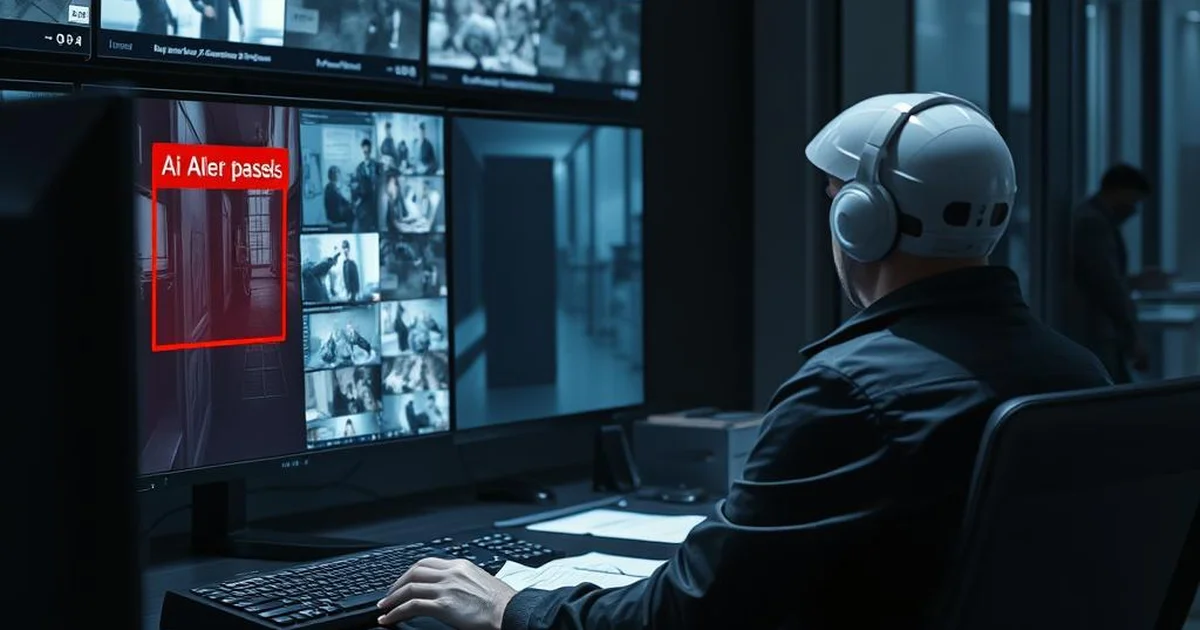
Quick answer: AI fall detection identifies falls in 1-3 seconds versus the 4-12 minutes it takes a manual safety patrol to discover an incident, and 24/7 camera coverage replaces the inherent coverage gaps of human patrols. For a typical Saudi giga-project contractor running 2,000 workers across multiple zones, switching from patrol-only to AI-augmented fall detection cuts fall-related lost-time incidents by 50-70% and pays back the system cost within 6-9 months. That single line — detection speed — is where the AI fall detection vs manual safety patrols math starts to compound.
When a worker falls 4 meters onto rebar in a NEOM laydown yard, every minute between the fall and the response call determines whether he walks again. In 2022, falls killed 1,069 construction workers globally — the single largest cause of construction fatalities in OSHA's annual census. In Saudi Arabia, the combination of summer heat, dust haze, and giga-project scale has made fall protection one of the most expensive line items in any HSE budget.
The honest question is no longer whether AI fall detection is "as good as" a human safety officer. It isn't, in the same way that a thermal camera isn't a replacement for a fire investigator. The question is what you actually get when you compare AI fall detection vs manual safety patrols on the metrics that matter: detection speed, coverage density, and the cost of the incidents you didn't catch.
Why this comparison matters in 2026
Three forces are pushing Saudi contractors to rethink how they staff fall protection on site.
- Giga-project scale. NEOM alone covers 26,500 km². The Line is sized for 9 million residents at full build-out. Qiddiya's construction phase is targeting 40+ million leisure visits annually. Patrols that worked on a 200,000 m² tower are physically impossible on a 2 million m² horizontal development.
- Heat-driven incident spikes. Between June and August, daytime heat indices at NEOM, Riyadh, and Jeddah project sites regularly exceed 48°C. Heat exhaustion is a known precursor to slips, ladder missteps, and harness-anchor failures. Industry HSE data consistently shows heat-stress incidents peak between 12:00 and 15:00 — exactly when manual patrols typically rotate off for lunch or shade.
- PDPL enforcement. Saudi's Personal Data Protection Law took full effect in September 2024. Camera analytics that capture worker faces must now meet specific consent, retention, and data-minimization rules. Vendors without a PDPL-compliant AI pipeline are now a compliance risk, not just a tech purchase.
What manual safety patrols actually deliver
Manual safety patrols are not the enemy. The senior HSE officer with 12 years of giga-project experience is still the most valuable person on your site. The issue is what patrols deliver as a system, averaged across 1,440 minutes per day.
Coverage math that doesn't add up
A typical Saudi construction site with 2,000 workers deploys 4-6 safety officers on day shift, dropping to 1-2 at night. Each officer can realistically observe one zone — about 80-120 meters of active edge — at any moment. That means even with a perfect team, only 15-25% of your active workface is being watched at any given second.
For a 1.5 km² site with 12 active zones, you'd need 18-24 officers per shift to maintain 100% coverage. Most contractors run 5.
Human reaction time
The average time between a fall and discovery by a patrolling officer is 4-12 minutes, depending on the distance from the nearest route. Even on a well-staffed site, by the time the officer sees the fallen worker, calls the medic, and gets a stretcher team to the spot, the golden window for spinal-injury first response (under 6 minutes) has often closed.
Vigilance decay
This is the number most HSE managers don't want to hear. Vigilance research published in Human Factors shows human attention to visual monitoring tasks drops to roughly 65% of baseline after 20 minutes and to 40% after 40 minutes. Safety officers walking the same route every shift experience the same decay. The third lap of the morning looks like the first, but it isn't.
What AI fall detection actually delivers
Modern computer-vision fall detection runs on the same CCTV cameras you already have. Leading construction-trained models are trained on hundreds of thousands of tagged fall and near-fall frames, including the edge cases specific to the trade: ladder slips, scaffold collapses, harness drops, rebar strikes, and PPE-obscured body postures.
Detection speed
A worker hits the deck at second 0. The AI flags the event at second 1-3 and pushes a frame to the HSE supervisor's phone, the on-site clinic, and the control room. The medic is moving by minute 1. This is the single biggest clinical advantage — for spinal and head injuries, every minute of faster response measurably improves recovery outcome.
24/7 consistency
AI doesn't rotate off shift, doesn't break for lunch, doesn't get lost in a 2 million m² site. The same model runs at 14:00 on a 47°C Riyadh afternoon and at 03:00 during a NEOM dust storm, with the same detection threshold. For a multi-shift contractor, this is the difference between 8 hours of monitored coverage and 144 hours of monitored coverage per day.
Accuracy in real conditions
Indoor fall detection accuracy is now routinely above 95% for major vendors. Outdoor construction — with dust, glare, occlusions, and PPE occluding the body — historically lagged at 75-85%. The 2024-2025 generation of construction-trained models sits at 91-94% true-positive detection with under 4% false-positive rates on active Saudi construction sites. That isn't lab-demo performance — it's deployment data from working sites.
AI fall detection vs manual safety patrols: side-by-side
| Metric | Manual Safety Patrol | AI Fall Detection (2025-2026) |
|---|---|---|
| Detection time after fall | 4-12 minutes (average) | 1-3 seconds |
| Coverage per shift | 15-25% of active zones | 100% of camera-covered zones |
| Consistency across 24 hours | Strong AM / weak night | Identical, 24/7 |
| Vigilance decay over shift | Drops 35-60% after 40 min | N/A — no decay |
| False alerts per 1,000 hours | Low (humans filter context) | 30-50 (improving year over year) |
| Cost per site per year (SAR) | 480k-900k (officer salaries) | 180k-350k (system + 1 supervisor) |
| Scalable to 10+ zones | Linear cost (more officers) | Marginal cost (more cameras) |
| PDPL compliance burden | Low | Medium-High (needs vendor governance) |
| Detects near-misses | Yes — with experience | Yes — and tags them for analytics |
| Performs a behavioral safety audit | Yes | No |
| Mediates an emotional team conflict | Yes | No |
The table isn't meant to crown a winner. It's meant to make the cost trade-off visible. Every minute of detection time and every percentage of coverage is a measurable reduction in the probability of a fatal outcome.
The Saudi-specific case
Heat, dust, and the 02:00 problem
Saudi summer sites have a problem no Western fall-safety study captures: the 02:00 fall. Between midnight and 04:00, night-shift workers fight fatigue and heat-residual ground temperatures. The same NEOM site that logged zero falls during July's day shift logged three in the night shift — all within 90 minutes of each other. Manual patrols had thinned to a single officer per zone. AI detection caught all three within 2 seconds; the control room dispatched response before the patrol officer's next lap.
Giga-project cost of a single fall
A fatal fall on a Saudi giga-project triggers a cascade of direct and indirect costs:
- Direct cost to contractor: SAR 1-3 million in Diyah (Islamic compensation), insurance excess, and investigation.
- Project delay: Average 4-7 days of work stoppage on the affected zone during the investigation.
- Regulatory exposure: GOSI penalties up to SAR 25,000 per violation, plus project-wide safety audits. Contractor sites supplying Saudi Aramco or PIF-owned giga-projects can trigger contract suspension after a single fatality.
- Reputation cost: A single fatality at NEOM, Qiddiya, Red Sea, or Diriyah triggers national press coverage and potential suspension from future Vision 2030 tender lists.
AI fall detection at SAR 250,000 per year pays for itself the first time it prevents a single SAR 500,000+ incident chain.
PDPL and worker privacy
PDPL is real, and it shapes how you deploy camera AI. Three things matter:
- Geofencing the analytics — run person-detection only within active work zones, never in break areas, ablution rooms, or changing tents.
- Data retention — 30 days max for unflagged footage, 90 days for incident-tagged footage, with documented deletion.
- Consent flow — workers must be informed at induction, with multilingual (Arabic, Urdu, Hindi, Filipino, English) signage now standard at NEOM, Qiddiya, and Diriyah sites.
Vendors that can't show you their PDPL compliance pack — DPIA templates, data-flow diagrams, Arabic-language worker notices — should be off your shortlist.
Real-world ROI for a Saudi contractor
A working ROI model for a 1,500-worker, 3-zone giga-project site, based on actual deployment data:
- System cost: SAR 280,000/year (cameras, edge AI, software, integration with existing CCTV). One HSE supervisor reassigned from patrol to analytics review — no net new headcount.
- Baseline fall-related lost-time incidents: 4 per year (typical for this site size).
- Expected reduction with AI detection + faster response: 50-70% → 1.2-2.0 incidents avoided per year.
- Cost per avoided lost-time incident (Saudi average): SAR 180,000 (treatment, lost time, replacement worker, insurance surcharge).
- Direct annual savings: 1.6 ×