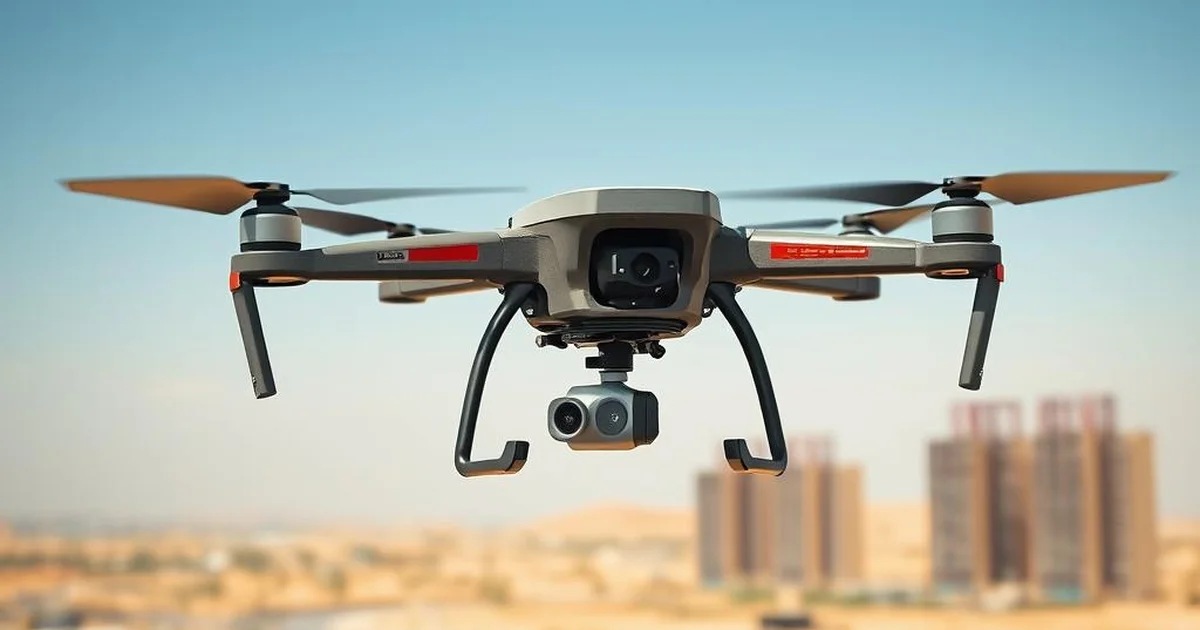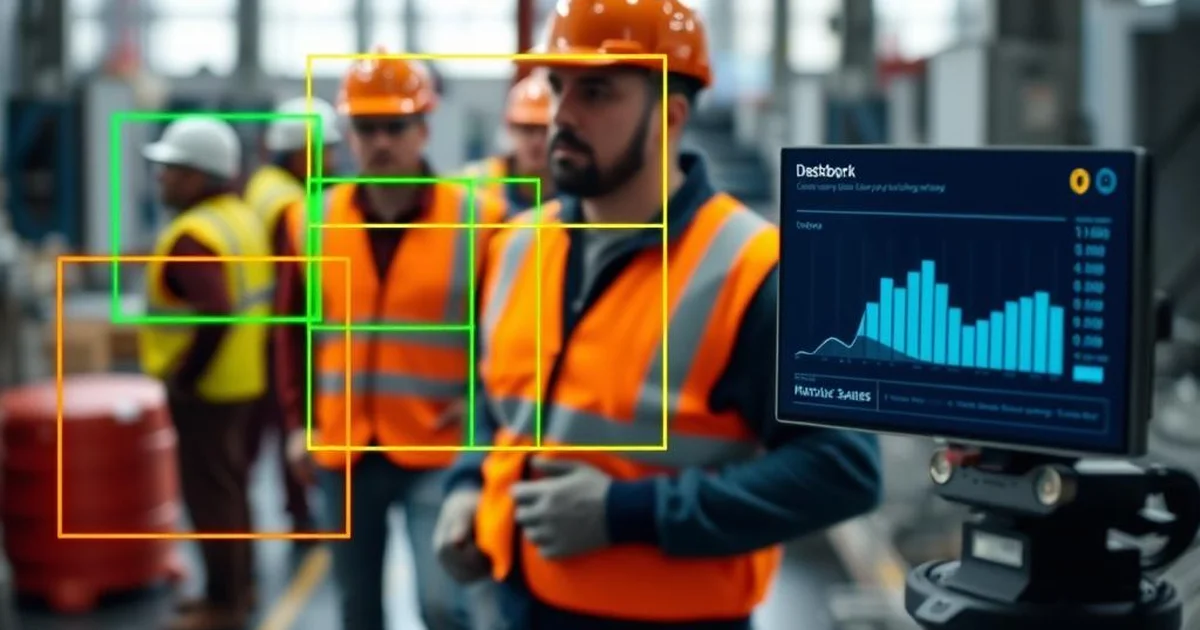
An AI safety compliance audit on a Saudi construction site is a documented, evidence-backed review that uses drones, fixed AI cameras, and PPE/heat-stress detection models to verify your site meets Saudi HSE rules, PDPL camera rules, and GACA drone rules — not a clipboard walkdown. The audit runs in five phases: scope and regulator mapping, data capture (drone + fixed AI), automated detection of PPE breaches, heat-stress incidents, and perimeter intrusions, evidence packaging with timestamps and GPS, and finally a remediation register tied to your HSE system. Done properly, it cuts audit time by roughly 60–70% and produces the kind of timestamped video evidence that holds up in client, Royal Commission, and PDPL reviews.
What "AI safety compliance audit" actually means on a Saudi site
A traditional safety audit is a human walking a site with a checklist. An AI safety compliance audit Saudi construction teams run today layers three things on top of that walkdown:
- Aerial capture — drones survey the full site footprint, towers, and laydown areas in hours, not days.
- Fixed AI video analytics — cameras at gates, scaffold access points, and hot work zones run PPE detection, fall-arrest checks, and heat-stress monitoring 24/7.
- Evidence layer — every detection is geotagged, time-stamped, and exported as a clip your HSE team can attach to an incident report, a client monthly report, or a Royal Commission submission.
The point isn't to replace your safety officer. It's to give your safety officer 10x the coverage and a paper trail that survives any audit.
Saudi regulatory context you can't skip before you start
Before you fly a drone or mount a camera, map your regulators. A construction site safety audit Saudi Arabia projects run into four overlapping authorities:
- GACA (General Authority of Civil Aviation) — any drone operation needs a permit. As of 2024–2025, GACA has tightened no-fly rules around giga-project perimeters, military sites, and royal commissions. Permit lead time is typically 5–15 working days depending on airspace class. Your drone operator must be GACA-registered and the pilot must hold a valid Remote Pilot License.
- PDPL (Personal Data Protection Law, effective September 2024) — every fixed camera on site is a personal data processor. You need a posted privacy notice, a retention policy (most Saudi sites cap at 30–90 days unless tied to an incident), and a lawful basis for processing worker biometrics if your PPE detection model uses face matching.
- Vision 2030 HSE alignment — giga-project clients (NEOM, Qiddiya, Red Sea Global, AMAALA, Diriyah) run their own HSE codes that sit on top of Saudi law. NEOM's contractor HSE scorecard, for example, weights AI-monitored KPIs and is tied to payment milestones.
- Royal Commission / local municipality — site-specific working hours, noise, and dust rules. In Riyadh summer, expect restricted outdoor heavy-lift windows between 12:00 and 15:00.
Skipping any of these is the single fastest way to turn an audit into a fine.
The 5-phase AI safety compliance audit process
Phase 1 — Scope and risk register (Day 1–2)
Pull your project HSE plan, your client's giga-project HSE addendum, and last quarter's incident log. Build a risk register grouped by Saudi-specific hazards:
- Heat stress (ambient 45–52°C in summer, WBGT routinely >30°C)
- Dust storms and visibility loss (hamal/haboob events, March–May)
- Working at height (NEOM tower work, Qiddiya scaffolding)
- Confined space in metro/MEP packages
- Lifting operations near live plant
- Vehicle-interface (dump trucks, telehandlers, tower cranes)
Tag each risk to a detection model: PPE compliance, fall-arrest harness detection, proximity alerts, fatigue/heat-stress posture, dust visibility, vehicle-pedestrian separation.
Phase 2 — Permits and PDPL paperwork (Day 2–7)
File GACA drone permits for the survey windows. Update your PDPL privacy notice and post it at every camera location. Confirm worker consent for biometric PPE detection — most contractors use signed acknowledgement forms filed with HR. Document retention rules: 30 days for routine footage, locked evidence locker for incidents.
Phase 3 — Data capture (Day 7–14)
Run a hybrid capture:
- Drones — 2–4 flights per week, RTK/PPK GPS, 4K video, 20–30 min per flight, dawn or dusk to avoid Saudi midday heat distortion. Coverage: 100% of site footprint, plus tower and roof inspections that would normally need rope-access teams.
- Fixed AI cameras — 8–24 cameras per active zone, edge inference on PPE (hard hat, hi-vis, harness, goggles, gloves), fall detection, vehicle-pedestrian proximity, smoke/fire, and heat-stress micro-posture.
- Wearable data (optional) — biometric wristbands on a sample cohort for ground-truth heat-stress thresholds.
Phase 4 — Automated detection and review (Day 14–21)
Models flag events in real time. Your HSE team triages the queue — typically 1,200–3,000 events per day on a 50,000 m² active site, of which 5–15% are true violations after human review. The rest are false positives, model noise, or duplicate frames.
Key metrics to track per week:
- PPE compliance rate — target 95%+. NEOM giga-project contractor scorecards typically penalize anything below 90%.
- Heat-stress incidents — number of WBGT-flagged stop-work events.
- Fall-arrest breaches — count of workers detected above 1.8 m without harness clipped.
- Vehicle-pedestrian near-misses — distance threshold breaches at crossings.
- Dust-visibility stop-work compliance — yes/no on hamal protocol trigger.
Phase 5 — Evidence pack and remediation register (Day 21–28)
Export a timestamped evidence pack: video clip + GPS + worker ID (anonymized per PDPL) + linked incident ticket. Feed every violation into a remediation register with owner, due date, and closure photo. Submit to the client HSE portal monthly. Close the loop with a model-tuning pass — false positive rates should drop 20–30% by audit 2 as the model learns your site's PPE patterns, scaffolding, and lighting.
Audit method comparison: manual vs drone-only vs AI video vs hybrid
This is the comparison most Saudi contractors ask for. Pick the row that matches your site size and client.
| Method | Coverage (50,000 m² site) | Time to complete | Evidence quality | Cost per audit (SAR) | Best for |
|---|---|---|---|---|---|
| Manual walkdown only | ~15–25% | 3–5 days | Photos, paper notes | 8,000–15,000 | Small fit-out, low-risk |
| Drone-only | ~70–80% | 1 day flight + 1 day review | 4K video, geotagged | 18,000–30,000 | Quarterly progress + safety overlay |
| Fixed AI video only | Gates + camera zones (~40%) | Continuous | 24/7 clips, auto-flagged | 25,000–45,000/month opex | Long-term sites, 12+ months |
| Hybrid (drone + fixed AI + manual spot check) | ~95%+ | 2–3 days per cycle | Multi-source, court-grade | 35,000–60,000/month opex | Giga-project contractors, NEOM/Qiddiya |
For most Saudi giga-project and tier-1 main contractor work, the hybrid model wins on both cost-per-detection and audit defensibility.
Saudi-specific risk categories the AI must catch
- Heat stress and dehydration — WBGT monitoring, micro-posture slumping, work-rest cycle compliance during June–August.
- Sand and dust occlusion — camera lens cleaning SOPs, model retraining on dust-obscured frames (a real problem, not theoretical — haboobs can drop visibility to <100 m in minutes).
- Hijri calendar working patterns — Ramadan shifts, Eid site stand-downs, and Friday prayer pauses all change the detection baselines. Your model needs a calendar-aware threshold.
- Multilingual signage and induction — PPE detection works on gear, not language, but your evidence captions and incident reports should be Arabic + English for the Royal Commission file.
- Royal Commission perimeter rules — some giga-projects forbid any imagery of the boundary wall or worker accommodation. Geofence your drone and your camera analytics accordingly.
What good looks like: KPIs to put in your audit report
- PPE compliance ≥ 95% (NEOM contractor baseline)
- Mean time to PPE breach alert < 8 seconds
- Heat-stress stop-work events logged with WBGT reading + worker ID
- 100% of GACA-permitted flights with logged takeoff/landing + pilot license copy
- 100% of fixed cameras with current PDPL notice posted and dated
- Audit cycle time reduced from ~10 days (manual) to ~3 days (hybrid)
- 30%+ drop in repeat violations by audit 3 (model learning effect)
Common gaps that fail Saudi audits
- No GACA permit on file — instant fine, drone footage inadmissible as evidence.
- Cameras in worker rest areas — PDPL breach, exposure to criminal penalty.
- No retention policy — footage kept for 12 months "just in case" is a PDPL violation.
- Heat-stress protocol not triggered — if WBGT > 30°C and you have no logged stop-work, expect a finding.
- Evidence pack without Arabic translation — Royal Commission reviewers will reject the file.
- Drone flights over worker accommodation — Royal Commission hard stop on giga-projects.
Frequently asked questions
How long does an AI safety compliance audit take on a Saudi construction site?
For a hybrid audit (drone + fixed AI + spot check) on a 50,000 m² site, plan 21–28 days end-to-end: 1 week for permits and PDPL paperwork, 1 week for data capture, 1 week for triage and detection review, and 3–4 days for the evidence pack and remediation register. Repeat cycles shrink to 7–10 days once the model is tuned to your site.
Do I need a GACA permit for every drone flight on a Saudi construction site?
Yes. Any commercial drone operation on or near a construction site in Saudi Arabia requires a GACA permit, a GACA-registered operator, and a pilot with a valid Remote Pilot License. Lead time is typically 5–15 working days. Flying without a permit is a violation under GACA's airspace rules and will also invalidate the footage as audit evidence.
How does PDPL affect cameras on a Saudi construction site?
PDPL treats any fixed camera capturing identifiable workers as personal data processing. You must post a privacy notice in Arabic and English at every camera location, keep a documented retention policy (30–90 days is the market norm), and have a lawful basis for any biometric processing. Camera footage used only for safety detection, with proper retention and access controls, is generally compliant — but a camera in a worker rest area or bathroom is not, regardless of purpose.
What AI detection models matter most for Saudi site safety?
The five with the highest ROI in Saudi conditions are: PPE compliance (hard hat, hi-vis, harness, gloves, goggles), fall-arrest harness check at height, vehicle-pedestrian proximity, heat-stress micro-posture combined with WBGT feeds, and dust-visibility / haboob protocol triggers. Each maps to a Vision 2030 HSE KPI that giga-project clients score you on, so the audit outputs double as commercial evidence.
The bottom line
An AI safety compliance audit Saudi construction teams can defend in front of NEOM, Qiddiya, or a Royal Commission reviewer is a hybrid system — GACA-permitted drones for footprint and tower coverage, fixed AI cameras for 24/7 PPE and heat-stress detection, and a human HSE team turning flagged events into a remediation register. Get the permits and PDPL paperwork right first, instrument the highest-risk zones second, and let the model learn your site over three cycles. The result is faster audits, cleaner evidence, and a measurable drop in repeat incidents.
ViewKeeper runs AI safety compliance audits for Saudi giga-project and tier-1 contractors — drone surveying, fixed AI video analytics, PDPL-aligned camera programs, and a remediation register that drops straight into your client's HSE portal. Book a site walkthrough to see what your next audit cycle could look like.